Ride the Wave

Uncertainty is inherent when investing, and that uncertainty is loudest in the short-term. It seems like there is always something to be afraid of, or a new opportunity to get in front of. Whatever it is, many investors try and act at the perfect time to either protect their portfolio against risks, or to get the biggest gain from investing early in an opportunity. Unfortunately, timing investments has shown to be just as much of a losing portfolio strategy as stock picking (remember, a diversified portfolio wins). Stay the course with respect to your financial plan and ride the ups and downs for a winning portfolio.

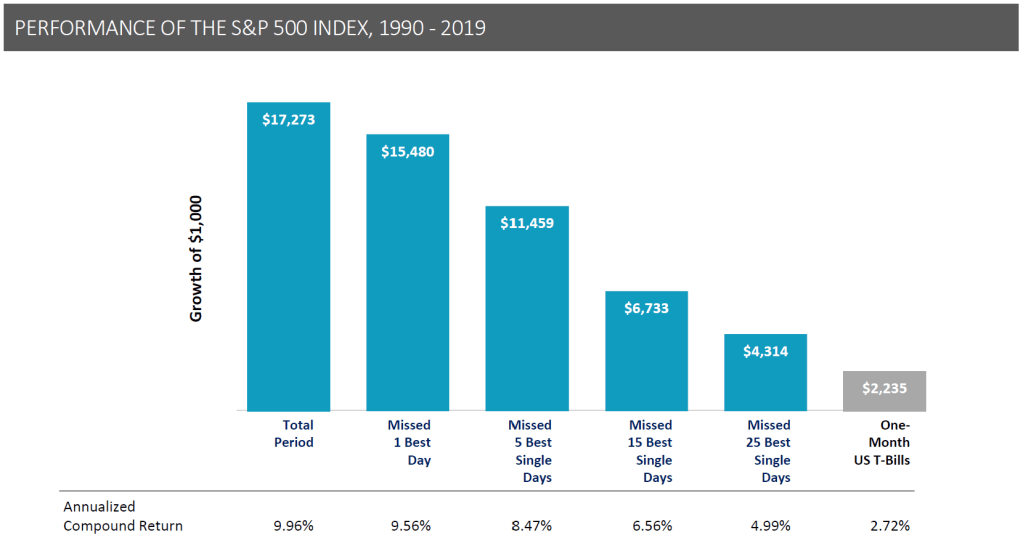
Here’s one of my favorite charts:
Source: Durbin Bennett Private Wealth Management, 2020

The data highlights that it can be very expensive to miss out on even one day out of 30 years of market returns. If you miss out on 30 of the biggest days (out of 30 years, not per year for 30 years), your portfolio ends up performing just better than inflation, while carrying equity-like risk. These 30 years include The Great Recession and The Dot-Com Bubble and the benchmark portfolio still returns exactly what we expect stocks to do over the long term (~10%), but that’s only if you had stayed the course during times of uncertainty. After a big drop in the market, a lot of people tend to get out of their investments and hold cash until the market recovers or stabilizes because they fear losing even more on their investments. By doing this, they risk losing out on the biggest earning days that make up a large portion of overall returns. It’ll take these investors more time to recover their earlier losses.

If market volatility makes you uneasy, that’s okay. That’s why great investors diversify their portfolio across multiple asset classes. For most of us, we can add bonds as ballast to the portfolio for a smoother investor experience. Control what you can control – it’s hard to control what the public stock and bond markets are going to do, but you can control how much you invest in either to have more control over the volatility your financial plan can handle. A lot of this has to do with the time horizon regarding your financial goals.

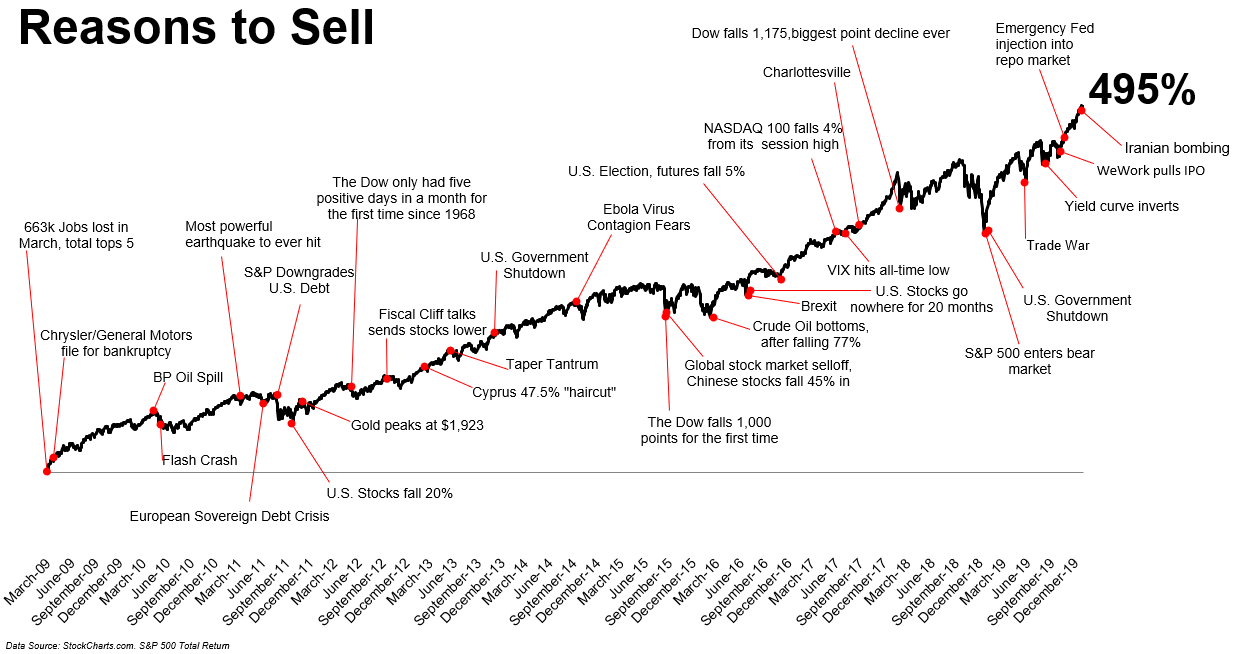
Here’s another chart I love.
https://www.thechartreport.com/cotd-01-08-20/

Someone is always touting a reason for doomsday. Sure the markets certainly experience some volatility in the short term, but they’re usually wrong in the long-term and by trying to front-run the end of the world, you could have potentially lost out on one of the longest bull markets in American history.

I don’t know the future impact of Covid-19 on the stock market. I don’t know the effects of the upcoming 2020 Election (VOTE!). I don’t even know what else I need to be worried about to try and get ahead of. I do, however, know what kind of returns to expect in the markets over the long term to be a successful investor with regard to my financial plan. Stick to your allocation and control only what you can control.

Compliance stuffs
Just remember, I’m not your financial advisor so the information may or may not best apply to your situation and you should get formal advice prior to doing anything. The information/data that is shared should be double checked by you and any conclusion that is driven based on past data is not to be interpreted as my advice for your future. I will do my best to only write what I think is true and right, but mistakes happen and we’re all learning together – this is meant to be a conversation. My employer has nothing to do with this blog – in fact, they’re probably upset I’m writing here instead of working.

Just Buy Everything

Investing can be a be a powerful tool to aid your financial plan. Think of it as a disciplined savings strategy, not something to make you rich overnight- looking at you, Robinhood traders. Don’t overthink it and keep it simple for the best results.

The data shows that trying to pick the best stocks doesn’t work for many of us. From 1996 through 2015, Dalbar Inc conducted a study that showed the S&P 500 index (the largest 500 American companies) returned ~10% annually (right in line with long term expectations), while the average retail investor’s (average Joe’s like you and me) return was a paltry ~5%. Even institutional managers who spend all day trying to find the best companies tend to fail. A SPIVA® report showed that 90.46% of professional managers failed to beat the S&P 500 index over a 15 year time horizon through 2019. I’m sure if you added in trading fees and taxes, the gap would be even worse.

So stop trying to pick the best ones and just construct a portfolio that mimics the index. You’ll be a diversified investor and your returns will fall within the expected averages over the long term (stocks earn 10%, bonds earn 5%). As funny as it sounds, relinquishing control of your investments actually lets you be in control of your balance sheet and financial plan. Now you won’t sound as cool as your friends bragging about their hot stock, but you will be better off than them over the long term.

When I say “just buy everything”, that doesn’t mean go out and buy a share of every single company in the entire world. Thanks to exchange traded funds (ETFs) and mutual funds, it’s incredibly easy to get global stock market exposure with just one to three holdings for very cheap.

The chart below (provided by JP Morgan Asset Management) shows annual returns across different asset classes for the last 15 years. You’ll notice there are no patterns and the asset class that performs the best each year changes. Maintaining global exposure allows for a smoother investor experience thanks to the diversification of risk (see the asset allocation line) to allow you to feel more confident and on track with your financial goals.

Investing is supposed to be a strong tool to enable financial success. A lot of times we do too much and investments deter us from reaching financial success as soon as we should have. Allow the market forces to work for you and maintain a diversified global allocation to take full advantage of investing. Sure you won’t be able to brag about how much better you are than the benchmark, but that’s not what investing is about. Investing is a way to realizing realistic goals. Keep it simple so that your life is easier and you’re happier.

Compliance stuffs
Just remember, I’m not your financial advisor so the information may or may not best apply to your situation and you should get formal advice prior to doing anything. The information/data that is shared should be double checked by you and any conclusion that is driven based on past data is not to be interpreted as my advice for your future. I will do my best to only write what I think is true and right, but mistakes happen and we’re all learning together – this is meant to be a conversation. My employer has nothing to do with this blog – in fact, they’re probably upset I’m writing here instead of working.

Losses Can Be Good

Sell your losers to boost net returns and reduce your capital gains tax liability

Tax loss harvesting should go in coordination with rebalancing your portfolio. The idea is very simple – sell the investments you’re currently losing money on to offset your current tax liability or future tax liability. The taxes we’re talking about here are capital gains taxes, taxes you pay on profits whenever you sell an investment. By selling an investment at a loss, the IRS allows you a loss benefit that is subtracted from gains on other investments you’ve sold, reducing (and possibly eliminating) your taxable profits.

Taxes take away from your net return and so tax loss harvesting optimizes your portfolio to increase your portfolio’s net return. Wealthfront (an automated portfolio manager) did a study to show that tax loss harvesting increased performance by 3.12% to 6.24% for their clients in 2018, depending on the client’s tax rate bracket. This is going to vary from year to year as we need losses and volatility to impact the portfolio (which we have a lot of this year in 2020), but this shows that tax loss harvesting will materially benefit your portfolio.

When you rebalance your portfolio, always sell the positions (you may have to get tax-lot specific) with an unrealized loss and buy back into another position that gets your portfolio allocation back to target. Watch out for wash-sale rules. Basically, you can’t buy back into the exact same position that you’re harvesting. You have to wait at least 30 days to do so or you can buy something else right away that has similar characteristics.

Behavioral finance studies suggest that people tend to hold on to their losers because it’s hard to admit and move on from a bad pick. This is called the disposition effect. I believe passive, globally diversified investors don’t have that issue because we’re focused on a target allocation defined by our long term financial goals and hold ETFs/mutual funds instead of individual positions we’ve bet on. This type of portfolio management strategy eliminates most of the emotional pitfalls of investing because we know that a diversified portfolio held long term will generate the expected returns. We know that a diversified portfolio has uncorrelated assets that move in different directions and that will lead to losses in some asset classes in the short run. Tax loss harvesting allows you to take advantage of that short term volatility while remaining invested in the asset class as a long term investor.

Another benefit of harvesting losses is that if you have more losses than gains to offset, you can also apply up to $3,000 of losses to reduce your ordinary tax liability (the tax you pay as a portion of your income).

In addition to rebalancing, tax loss harvesting is another to do item for periodic portfolio maintenance that all investors should be doing.

Compliance stuffs
Just remember, I’m not your financial advisor so the information may or may not best apply to your situation and you should get formal advice prior to doing anything. The information/data that is shared should be double checked by you and any conclusion that is driven based on past data is not to be interpreted as my advice for your future. I will do my best to only write what I think is true and right, but mistakes happen and we’re all learning together – this is meant to be a conversation.

Time to Trade

Once a quarter, tend to your portfolio and rebalance to your target allocation

You’ve heard the age old advice to buy and hold your investments, remain diversified, and to dollar cost average with every paycheck to invest more. That’s all fine and dandy but even a passive portfolio requires upkeep and maintenance.

Maybe you’ve decided your target allocation is 80% stocks, 20% bonds, or maybe you’ve assigned real estate or alternative/satellite investments to your target allocation. Whatever it is, all these asset classes are somewhat uncorrelated and move differently. Over time, the actual allocation will look very differently than your target allocation if you never rebalance it – buy the underweight classes and sell the overweight classes.

Remember, you set your target allocation based on the return needed to accomplish your financial goals with the least amount of risk. If you don’t rebalance, you could be invested with too much risk or with an allocation that’s unlikely to grow at the return that’s needed.

Rebalancing more than each quarter (three months) is too much trading and you’re in a position where you’re reacting to the markets again (especially in the 24 hour news cycle these days). It’s not uncommon for investors to rebalance at a frequency of every six months, or even one year. At some point this becomes more about comfort than anything else but I wouldn’t recommend waiting longer than a year. Nonetheless, the important thing is to rebalance. It’s like getting a haircut – we all have a different length of hair we think looks best on us and it grows at different speeds, so we go to the barber at different frequencies. But we all go to the barber when things get messy, otherwise we just look ugly.

Rebalancing should be done in coordination with tax loss harvesting.

Compliance stuffs
Just remember, I’m not your financial advisor so the information may or may not best apply to your situation and you should get formal advice prior to doing anything. The information/data that is shared should be double checked by you and any conclusion that is driven based on past data is not to be interpreted as my advice for your future. I will do my best to only write what I think is true and right, but mistakes happen and we’re all learning together – this is meant to be an informal conversation.


Savings vs Debt vs Investing

While everyone’s financial plan differs in some way, we’re still united by the common goal of growing our net worth so that we have enough capital to fuel the lifestyle we’ve planned for. Assuming you have excess cash flow net of day to day lifestyle expenses and commitments, there are only three things you can do: save it, pay down debts, or invest it.

Save It
Having a cash buffer of savings is the top priority because life’s uncontrollable events can be potentially devastating to any progress made toward the financial plan and can even cause bankruptcy, forcing you to start over. These are events like losing an income or unexpected expenses like repairs or health care costs that aren’t covered by insurance. To mitigate the amount of damage and quickly recover, it’s important to have some dry powder (cash or cash equivalents) on the side. My old roommate in California liked to keep $10,000 as reserves, while a wealth advisor may tell you to have 3-6 months of living expenses saved up – it’s really up to you and your unique situation. In addition to random “what if” scenarios, you should also consider large, planned expenses upcoming in the next 6-12 months and ensure you are going to be able to satisfy those goals with a high degree of certainty. Having some dry powder to the side allows you to be more opportunistic about making larger purchases (whenever a deal too good to pass up comes up) or investments (huge market correction that allows you the opportunity to buy in again at lower prices) as well.

You should be comfortable about your savings buffer, however, you don’t want to be overly cautious and hold too much cash. This is because cash has a negative return when adjusted for inflation and it will be more difficult to increase your net worth to a level at a rate that’s required by your plan. When thinking about the buffer that’s right for you, consider the following:

  • What sort of risks does my financial plan face? Quantify this answer in terms of costs in dollars and duration.
  • How quickly can I recover from these financial risks?
  • If some event requires capital in excess of my savings, how can I make it up? What are the long term implications of this?
  • How much can insurance assist with uncontrollable damages? (Please don’t go buying insurance for every imaginable risk to your plan, insurance is much more complex than that)

Debt vs. Investments
After you’ve established a savings buffer, you have just two decisions to make with excess cash: pay down debt faster or invest. As an impact to your financial net worth, they can be thought of similarly. Any debt you have carries an interest rate, also known as the cost of borrowing. While investments help increase your net worth, accruing interest from holding debt decreases your net worth. That being said, not all debt is bad. Any debt that you’ve taken on to purchase assets likely to appreciate in value can be worth it if the interest rate is lower than the expected asset growth rate.

Take a look at the liabilities section of your Personal Financial Statement and dig into the interest rates. For example, revolving debts (credit cards) typically carry an interest rate of 15%-20% (if you don’t pay down your card every month). This is higher than the expected return on most investments and so it should be paid down before investing. As of June 2020, 30 year mortgage rates in Texas are 3.51% while Texas real estate has been appreciating at 6.74% annually in the last 5 years – this makes the mortgage worth keeping. The decision to pay down debt or invest cash is all about opportunity costs as you attempt to maximize the return of limited resources (cash).

Figure out a cash buffer first and then optimize the line items that maximize your net worth, whether that’s investing or paying down debts.

Compliance stuffs
Just remember, I’m not your financial advisor so the information may or may not best apply to your situation and you should get formal advice prior to doing anything. The information/data that is shared should be double checked by you and any conclusion that is driven based on past data is not to be interpreted as my advice for your future. I will do my best to only write what I think is true and right, but mistakes happen and we’re all learning together – this is meant to be a conversation. My employer has nothing to do with this blog – in fact, they’re probably upset I’m writing here instead of working.

Pay Day

Income is liquid fuel to a financial plan. A Cash Flow Table helps guide the Personal Financial Statement in the right direction.

The end of the month is pay day for many. This is an exciting time because you’ve earned the opportunity to either invest towards the financial plan, or realize benefits today. In reality, it’s probably a mix of both (let’s be honest, a little bit of fun too is healthy, right?) and it’s vital to plan proactively to know the right balance and avoid asking, “wait, where did my money go?”.

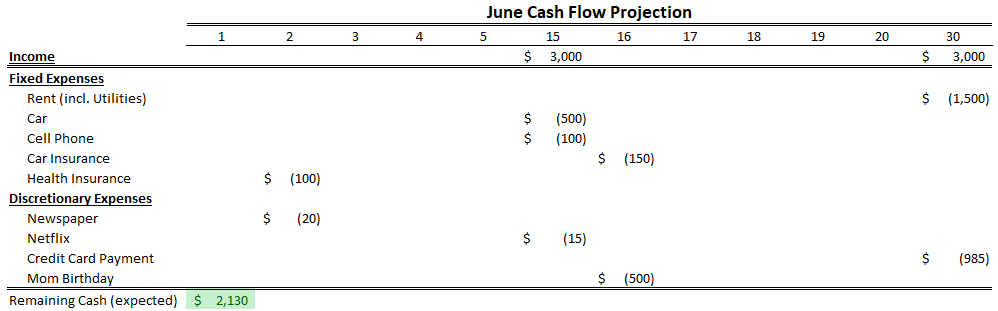
Maintaining a simple Cash Flow Table like the one below helps forecast cash needs into spending buckets with due dates. Visuals like this create a road map for how much cash is needed for what and when so it’s not accidentally spent on something else. There are many online services out there already to help maintain this data on your behalf so be sure to explore a bit.

This data is 100% made up and is to serve for illustration purposes only.

Organizing cash flow into spending buckets is important because it highlights how flexible incoming cash is. Implicitly, you’ve already committed portions of your income to be spent on fixed expenses (long term obligations like rent, car payments, utilities) and discretionary expenses (short term obligations that can be easily changed like entertainment, travel, hanging out) – ultimately this shows how much income you actually have power over.

Ideally there is cash remaining each month that can be allocated to fun things (a vacation, eating out at a restaurant, etc) or the future (saving up for a car, HSA contributions, or retirement plan contributions). If not, the expenses need to be adjusted and perhaps maybe it’s time for a change in lifestyle. If so, the extra cash is your dry powder that you need to plan for. This should inspire some reflection on your behalf. Some things to ponder:

  • Is my current lifestyle within my means or too expensive?
  • Is what I’m paying for indicative of what I value?
  • Which expenses do I need to plan for paying that may exceed my income in a month?
  • How much fun can I afford?

The answers to these questions will vary from person to person. Have the conversation with yourself on what matters and how much it matters. That conversation will inspire you to create/adjust/confirm a budget that’s aligned with your values. Your income is the easiest way to direct a successful financial plan so be in charge of it!

Compliance stuffs
Just remember, I’m not your financial advisor so the information may or may not best apply to your situation and you should get formal advice prior to doing anything. The information/data that is shared should be double checked by you and any conclusion that is driven based on past data is not to be interpreted as my advice for your future. I will do my best to only write what I think is true and right, but mistakes happen and we’re all learning together – this is meant to be an informal conversation.

Starting a Financial Plan

The first step to creating your financial plan is to create a Personal Financial Statement (PFS)

No, this is not a spiritual mission statement – I promise you it’s a real tool you can see and touch.

The PFS is simply a current allocation of your assets and liabilities; it looks just like a balance sheet. This financial statement is a really powerful tool because it’s impossible to create the financial path to the goals of tomorrow without knowing where you start off today. Another benefit is when your entire financial universe is right in front of you and shown numerically, you can assign each line item a purpose so that you are equipped with the right mindset to make decisions that are worth something.

That’s it, starting off is that straightforward. A Personal Financial Statement helps define point A so that you can get to B.

A couple of tips to get started below:

  • 1) Sample Personal Financial Statement
  • 2) Internal Conversation Starters

Sample Personal Financial Statement

Please remember this is just a sample, not a representation of a healthy statement or based on any real information (I made this up on the spot while thinking about if/what I should eat for second lunch #Quarantine2020). While it may make sense to initially build your ideal version in Excel, there is a lot of financial technology out there already that helps you build and maintain your PFS with more efficiency. Just like your investment accounts, this isn’t something that needs to be checked on daily but once a quarter is about right

I like to break out the allocation by liquidity, but you may prefer to do this based on goals, tax status, or maybe even time horizon. Experiment, see what works for you.

Internal Conversation Starters
So you’ve created your first PFS. Without asking questions and providing context, it probably doesn’t mean much to you. Here are some questions to ask yourself and color it in.

  1. Which assets need to do what to help you accomplish which goals?
  2. Which of your day to day actions are worth the cost financially to gain the life experience? How do you measure that?
  3. Is the debt worth the opportunity?

I hope this helps. Leave a comment and subscribe!

Compliance stuffs
Just remember, I’m not your financial advisor so the information may or may not best apply to your situation and you should get formal advice prior to doing anything. The information/data that is shared should be double checked by you and any conclusion that is driven based on past data is not to be interpreted as my advice for your future. I will do my best to only write what I think is true and right, but mistakes happen and we’re all learning together – this is meant to be a conversation. My employer has nothing to do with this blog – in fact, they’re probably upset I’m writing here instead of working.

Investing for Retirement

Should I invest my Roth or IRA first? Also what’s a 401(k)?

These are all accounts you invest in during your working years and spend during your retirement years. The main difference between them is when taxes are paid. Traditional IRAs and 401(k)s are tax deferred accounts while Roth IRAs and 401(k)s are tax free accounts. The type of tax we’re talking about here is income, or ordinary tax (what you pay as a percentage of every paycheck). If you’re already familiar with these accounts and just want the quick and easy optimization techniques, see below:

  • If you are in your early income years and think you’ll be living on a higher dollar amount in retirement, then pay taxes now and contribute to a tax free account

  • If you think you’re earning more now than what you’ll be living off of in retirement, contribute to a tax deferred account

  • If your employer provides a matching incentive, then contribute to your 401(k), at least up to their matching limit

  • If your employer doesn’t provide a matching incentive, then contribute to your regular IRA/Roth first and then anything in excess of the contribution limit to your 401(k). This is mostly just to alleviate administrative burdens later when you change jobs and/or want to transfer your 401(k) or want to rollover your 401(k) to your IRA. Especially recommended if you don’t think you’ll be contributing more than the IRA/Roth IRA limit each year. If you make more than $74,000 (as of 2020), your contribution deduction to a traditional retirement account is phased out so you’re better off just contributing to your 401(k).

That’s it from a general sense. Pretty simple, right?

Although these accounts are meant primarily for retirement planning, they have a lot more potential in your financial plan with respect to passing assets down, charitable giving, and tax mitigation. Before you do anything, consult with your financial advisor as there are large consequences for mistakes.

Hopefully this provides some comfort and/or next steps for you. Leave a comment and subscribe!

Just some more detail below on the main differences between these accounts:

Tax deferred means you pay tax the year which you take a distribution from the account and fund the account with pre-tax dollars. The pre-tax benefit is why they’re so appealing because they allow you to use a larger portion for yourself instead of it giving it away to taxes. This benefit is also advantageous because it allows for more control in the timing of taxes due and the taxable rate.

Tax free means no taxes on withdrawals (including all investment growth) because you have to fund the account with after-tax money (the portion of your paycheck that actually hits your bank account). Now assume you stay at the same income level, spend at the same rate, and your marginal tax rate remains the same for your entire life. Theoretically, there would be no net value difference in an IRA or a Roth IRA. Real life isn’t that simple though and there’s a time to use each.

A 401(k) can be tax deferred (traditional 401(k)) or tax free (Roth 401(k)) and are set up through your employer. The difference with the 401(k) tag is how much (determined by the IRS) you’re allowed to contribute in a given year. In a regular IRA or Roth IRA, you’re allowed to contribute up to $6,000 (combined, not each) while you can contribute up to $19,500 in your 401(k) in 2020. You can contribute to a 401k and an IRA/Roth account for a combined limit of $23,500 in 2020. Those that are over 50 can contribute a little more with catch-up contributions. All these limits are usually adjusted slightly upwards each year to account for inflation.

401(k) accounts have another advantage because employers will generally match (up to a certain limit) how much you contribute as an employee benefit. Most of these matches are up to 3% (check with your employer), which means if you contribute 3% of every paycheck, your employer will put in the same dollar amount for your benefit. That’s free money you’re missing out on by not contributing anything in your 401(k).

Which one is better: tax deferred accounts or tax free accounts? Well it depends on you. Refer back above to the optimization scenarios and select the option that best suits your scenario.

Compliance stuffs
Just remember, I’m not your financial advisor so the information may or may not best apply to your situation and you should get formal advice prior to doing anything. The information/data that is shared should be double checked by you and any conclusion that is driven based on past data is not to be interpreted as my advice for your future. I will do my best to only write what I think is true and right, but mistakes happen and we’re all learning together – this is meant to be a conversation.